
Home›Platform
Every system you install, in one place.
Helios Platform is cloud software for solar installers. It monitors the systems you have installed regardless of inverter brand, computes what they are actually worth against Cyprus tariffs, and carries the customer relationship from first lead through to service years later.
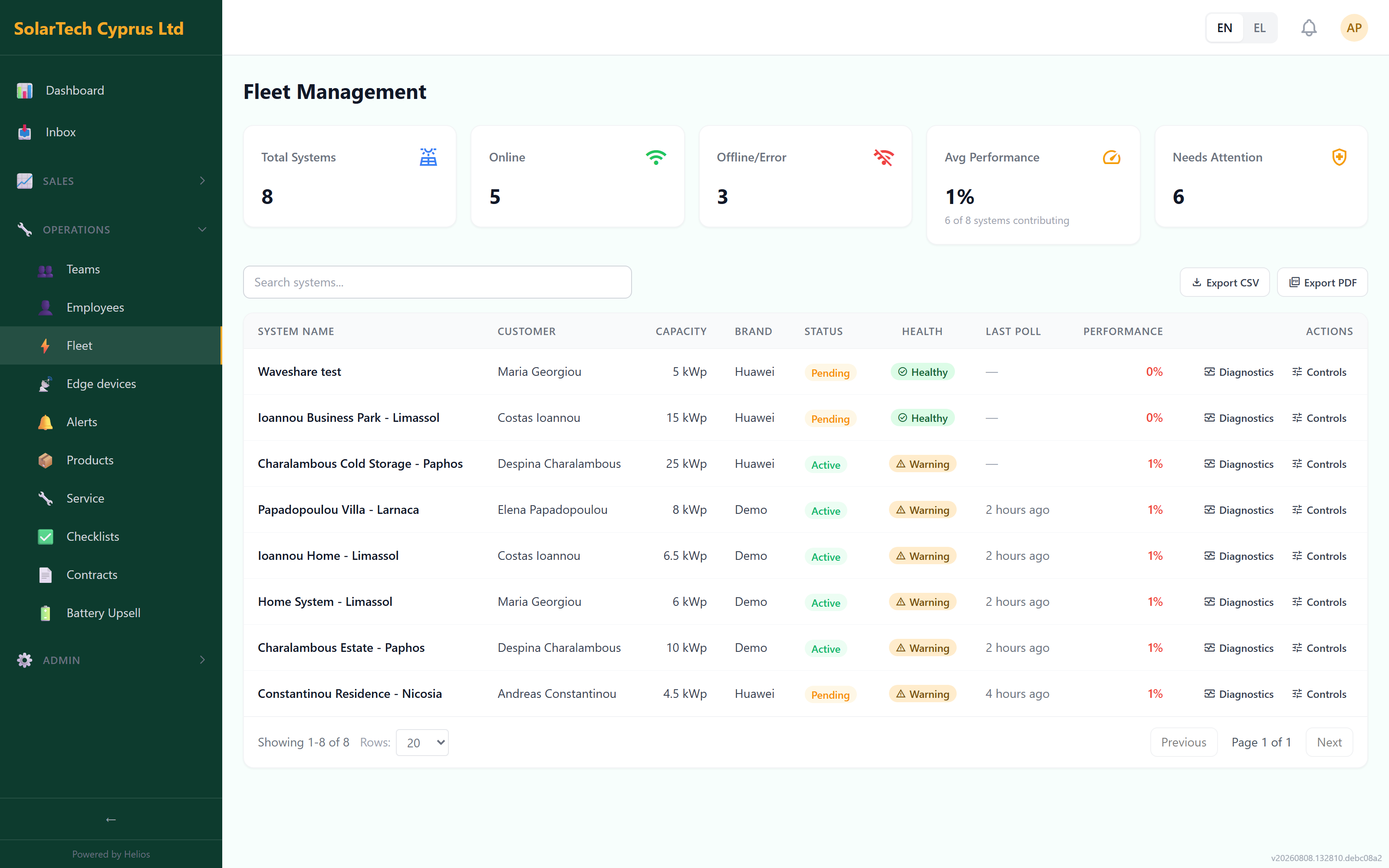
Monitoring across brands
Most installers end up with a mixed fleet, and one portal per manufacturer. Helios reads all of them through their cloud APIs and presents one fleet.
Fully verified with Huawei FusionSolar and SolarEdge. Integrations are also built for Sungrow, Fronius, Azzurro, SMA, GoodWe, Growatt and SolaX — these are real integrations, and they are validated against your fleet when a system connects. We would rather tell you that than claim nine-brand parity we have not proven.
How often the data arrives
Cloud APIs are polled every five minutes, which is as fast as vendor rate limits sensibly allow. Where a site has an optional Helios edge gateway — a small Modbus RS485 to MQTT device — readings arrive every 30 to 120 seconds instead, pushed rather than polled, which sidesteps the vendor API limits entirely.
So: near-real-time with an edge device, five-minute resolution without one. Both are honest descriptions of the same product in different configurations.
What you can see
- A live energy-flow view — production to home, to grid, to battery — updating over a live connection rather than on page refresh.
- Per-device energy breakdown, and per-phase and per-MPPT diagnostics: voltages, currents, temperatures, fault codes, conversion efficiency.
- Device-offline detection at three independent layers: polling failures, a 30-minute data-gap sweep, and per-minute watchdogs on edge gateways and EMS controllers. Recovery is detected automatically too.
- Automatic gap detection and backfill. This is Huawei-only today and we do not generalise it.
- Raw readings retained for five years under a GDPR-audited retention policy.
Detecting problems before the customer calls
Six automated detectors run over each system's telemetry every fifteen minutes. They split into two groups, and the distinction matters.
Three work from day one
- Sustained grid voltage outside the EAC grid-code band of 207–253 V.
- The same inverter fault code recurring repeatedly.
- One MPPT string under-producing against its sibling strings — the signature of shading, soiling or panel damage.
Three need history before they can say anything
- Inverter conversion efficiency falling below its own 30-day baseline.
- Battery charging behaviour degrading against a 12-week baseline.
- Monitoring-device radio signal deteriorating over time.
These three compare a system against its own past, so they need roughly 7 days to 12 weeks of history depending on the detector. They are not useful on a system commissioned yesterday, and we will not pretend otherwise.
Alerts carry the measured value, a plain-language likely cause and a repair suggestion, in English and Greek, and they land on the installer dashboard. They clear themselves when the condition resolves. Detection depth depends on what each brand's telemetry actually exposes — these detectors are designed to catch the categories above, not to catch any conceivable fault.
The battery detector is an early-warning trend indicator. It is not a state-of-health test and should not be presented to a customer as one.
Savings, reporting and what a system is worth
Production figures alone do not answer the question a customer asks, which is what the system is doing for their bill. Under net billing that gap is wider than it used to be — see net billing in Cyprus for why.
- Daily and monthly aggregates: production, consumption, import and export, self-consumption rate (calculated battery-aware), peak values, battery state-of-charge range.
- Savings in euro computed against a database-driven Cyprus tariff engine — EAC components, fuel adjustment, wholesale export rates. A rate change is a data change, not a software release.
- Virtual net billing settlement: a monthly credit ledger with a 36-month expiry sweep.
- CO2 avoided at the Cyprus grid factor of 0.707 kg/kWh, with a trees-equivalent figure.
- Expected versus actual production, genuinely irradiance-corrected using weather data rather than compared against a flat annual assumption. Curtailment and throttling detection for commercial sites.
- Customer-facing energy, savings and history reports with CSV and PDF export, plus a monthly report email.
- An ROI calculator and bill estimator, implemented once in the backend and once in the browser with enforced parity, so a proposal figure and an app figure agree.
Where a site reports production only, self-consumption has to be estimated, and the product marks those figures as estimated rather than presenting them as measured. Where there is no usable import price, the report shows no money figure at all rather than inventing one.
Control, stated precisely
What you can do to a system from Helios depends entirely on how that system is connected. There are three tiers and they are genuinely different.
| Connection | What Helios can do |
|---|---|
| Cloud API only | Monitoring only. This is deliberate — vendor APIs are rate-limited and permission-fragile, and we would rather not build control on that foundation. |
| Helios smart edge gateway fitted | Real control: inverter power limiting, on/off, restart, battery mode and schedule, minimum state-of-charge, forced charge and discharge. Destructive actions require a typed confirmation, and every command is audit-logged. Huawei is the field-validated brand; control rollout for other brands is brand-by-brand. The Waveshare bridge hardware is monitoring-only. |
| Helios Edge EMS site | The controller owns its control loop. The cloud cannot send it a setpoint — no such command type exists in the protocol. See Edge EMS. |
The installer side of the business
Monitoring is half of it. The other half is that most installers are running the commercial side across a spreadsheet, a mailbox and a filing cabinet.
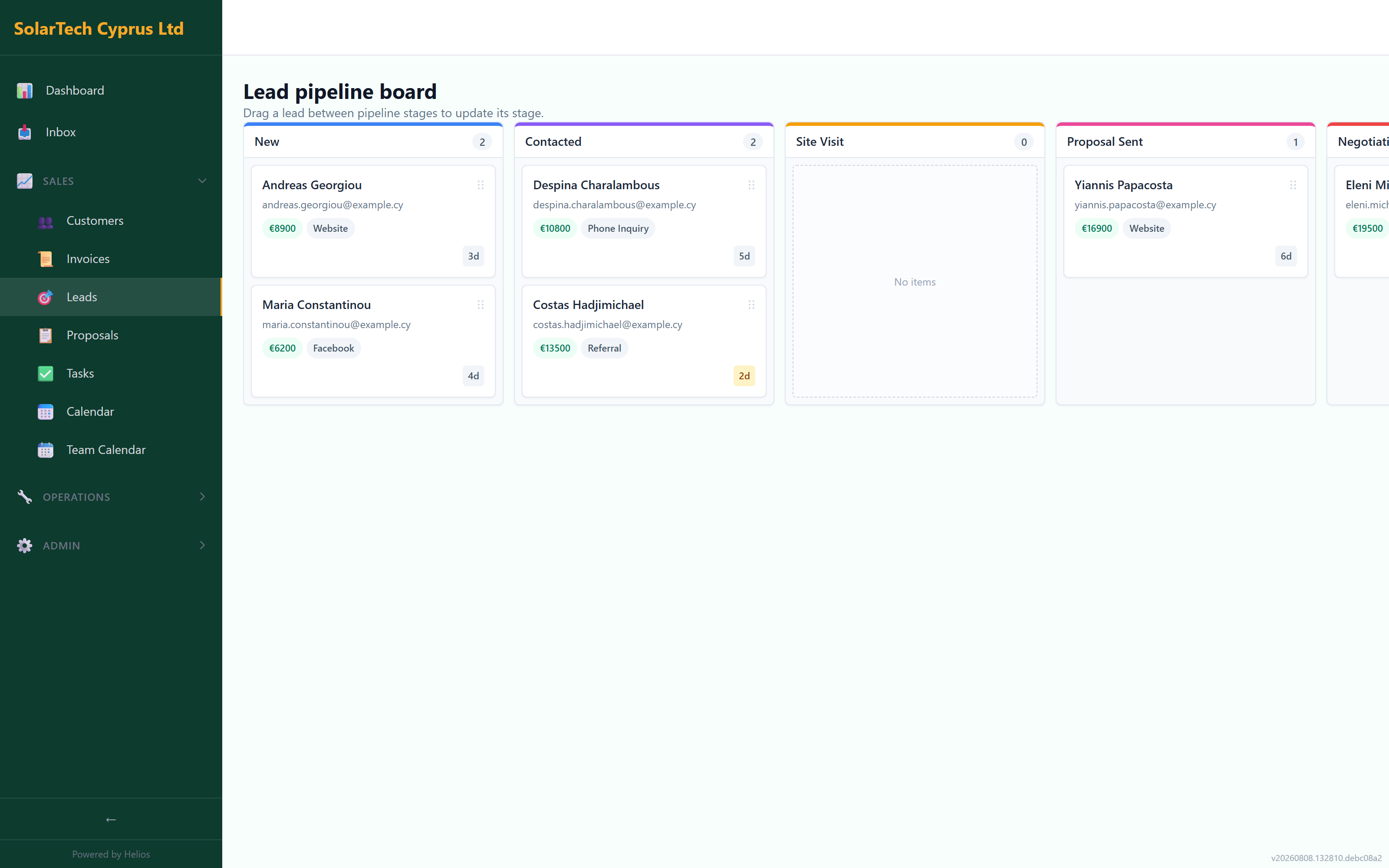
- Customers, leads with a kanban pipeline, and lead-to-customer conversion.
- Proposals carrying an ROI snapshot, e-signature settings, and a public acceptance link the customer can use without an account.
- Invoices including recurring ones, and payments through Stripe, with Viva Wallet available as a configured alternative.
- Service tickets and a service board, maintenance plans, visits and contracts, checklists, and an equipment register with warranty tracking and photos.
- Teams, employees, company roles and granular permissions.
- Tasks, a calendar and a team calendar, and an inbox with inbound email sync from Gmail or Microsoft.
- Workflow automation: triggers on pipeline stage changes, field updates and systems going offline or coming back; actions including notifications, task creation and round-robin assignment, with delays of up to a week.
- Custom fields, tags, a form builder with templates, document management and data import.
- White-label branding per organisation — your logo and colours.
Installer analytics covering sales performance, pipeline, revenue, team and service are available depending on plan.
Alerts
Alerts are delivered by email and in-app. That is the complete list — there is no SMS and no mobile push today.
Triggers include systems going offline and recovering, inverter cloud alarms with anti-spam cooldowns, temperature alerts, EMS safe-fallback events, a sustained performance-ratio drop checked weekly, and reminders for maintenance, contracts, invoices and trials.
Access, security and language
- Installer and customer portals, role-gated, with per-request tenant isolation so one organisation's data cannot be reached from another's session.
- TOTP two-factor authentication with recovery codes. Two-factor can be enforced for administrators.
- Audit trails: user activity, login and logout history, a control-command audit log, and impersonation that shows a visible banner while active.
- GDPR support: self-service raw-data export delivered as a signed link, plus retention and purge jobs.
- Fully bilingual English and Greek — 7,915 translation keys at 100% coverage in both, including server-side output.
- Responsive web, tested at mobile viewport sizes. Native mobile apps are in development; the web app works on any device today.
Read next
Helios Edge EMS is the on-site controller for solar-plus-battery sites. Pricing covers the installer plans. The FAQ answers the specifics — supported brands, what control really means, what happens to data.
See it on your own fleet.
Book a demo and we will connect a system and walk through what it shows.